
Reverse alien abduction cinema
He wanted to teach me about strangers. Instead, I learned to hate.

Starting at the age of two, I cut my teeth being educated at a Catholic elementary school that no longer exists. This would be the only time where I would not attend public school for my K-12 career, and you might be surprised at how these institutions varied in their experiences.
What do I mean by this? Well, first of all, my middle school—a public intermediate locale in Brooklyn—would start my day with free breakfast, library access, a coterie of Snapple vending machines, and bright, clean hallways. By contrast, the school that my parents paid money for me to attend had a significant roach problem and was lit like a haunted house.
Yes, not only did I have to wear a dopey little uniform where I would be penalized for forgetting my dopey little tie, but I was supposed to tolerate the fact that our staircases looked like a medieval dungeon with the hygiene to match.
Despite these tribulations, my experience in Catholic school was not entirely horrifying. We did occasionally get hours away from class to attend church, for instance. Without my free breakfast, by that point I was usually so hungry that I enjoyed the taste of a communion wafer. I also have quite a few pleasant teachers and made some happy childhood memories.
But perhaps the crown jewel of my elementary educational experience was what we would call library class.

It is very difficult to fill the day of a child with the simple four subjects of math, language, arts, history, and science. My school, with its many limitations, often got creative about what it could provide in those gaps in between. This included physical education, of course. Then computer class, where I learned how to use a floppy disk. And library class, where we were educated on things like the Dewey Decimal System and read books.
But by and large we mostly just watched movies.
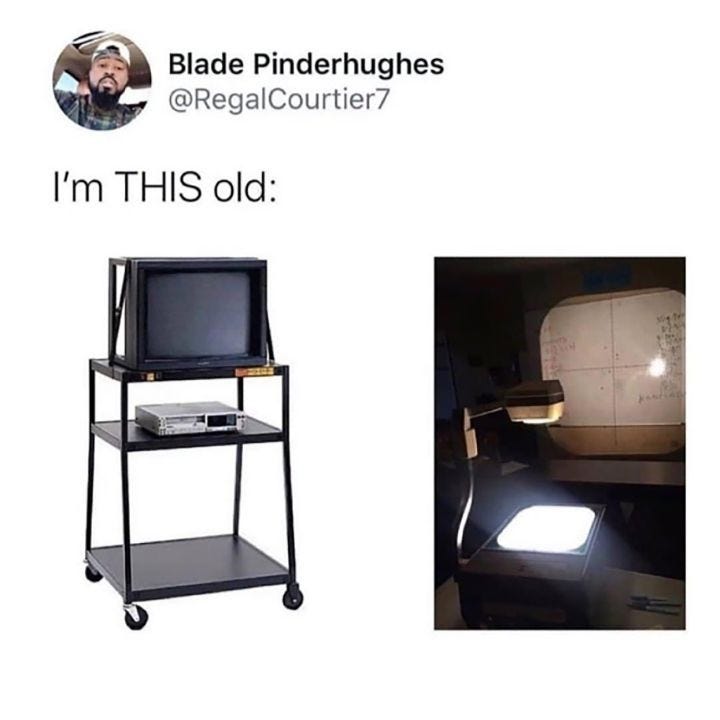
It was a known fact among my peers and I that library class functioned as a once-a-week opportunity to watch television for 45 minutes of the school day. This is not to say that our instructor was a slouch. Miss Lucy, God rest her soul, often went above and beyond and was highly favored by the student body for her demeanor and educational prowess. I mean, I do know what the Dewey Decimal System is.
But as I said, our funding wasn’t exactly above and beyond, and as such, our selection of books left much to be desired. Our teachers worked with the tools they were given. And believe me, they were not given much.
How do you solve a problem like a TV class?
Having a class that revolved entirely around entertaining young children with VHS tapes created its own unique challenge: curating material that justified spending an hour a week doing this.
This meant that the VHS tapes in question often had to have some kind of educational bent. This included the Bush Sr. era Just Say No special, Cartoon All Stars to the Rescue, which my class colloquially called “the drug movie.” We were rather fond of this particular film, I assume because it packed every popular children’s IP of the ‘80s into one presentation, and we insisted upon watching it every year in ritual fashion.
Imagine if you will a flock of seven year olds asking an elderly woman to show them “the drug movie.” Okay, onward.
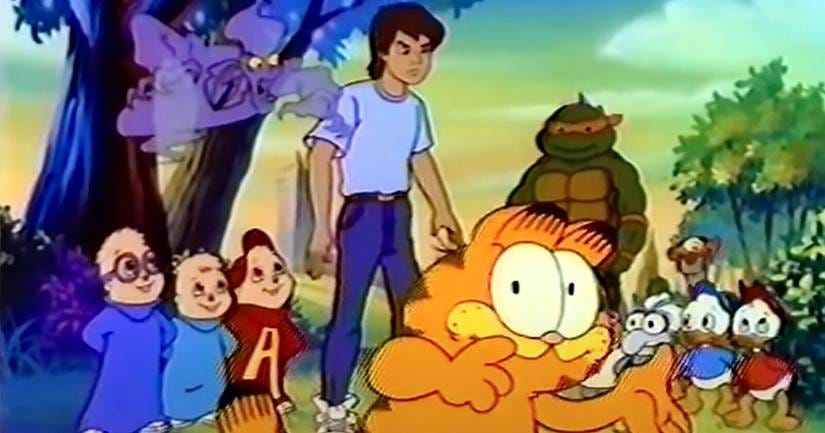
Initially, I would say that this interest in the special was earnest. We probably enjoyed watching Garfield and The Muppet Babies teach us why marijuana was dangerous, even though a good chunk of the kids in that room would be smoking cigarettes within less than 10 years. In truth, I think there was a proto-iPad Baby effect at play. The special was relentlessly colorful, stimulating, and packed with copyrighted characters interacting. Can we get some research on this?
They’re bigger, they’re badder, they’re from Brooklyn
Another critical component of my library class experience, however, was that the cynicism of getting older gradually crept in year after year, and in turn gradually impacted our perception of the content we consumed in the classroom.
This was an entirely normal part of childhood development, of course. As the innocence of your earliest years wanes, you start to realize how cynical and discouraging the world can truly be. Your outlook and demeanor become more cynical in turn. This is sometimes laundered into a somewhat more optimistic outlook by growing up and getting a more balanced view of life, and sometimes it just gets worse over time.
The point is, most kids go through a period in which their naiveté is transfigured into an all-consuming nihilism, especially towards the corny and saccharine films, books, and television shows that made up their media diet in the years prior.
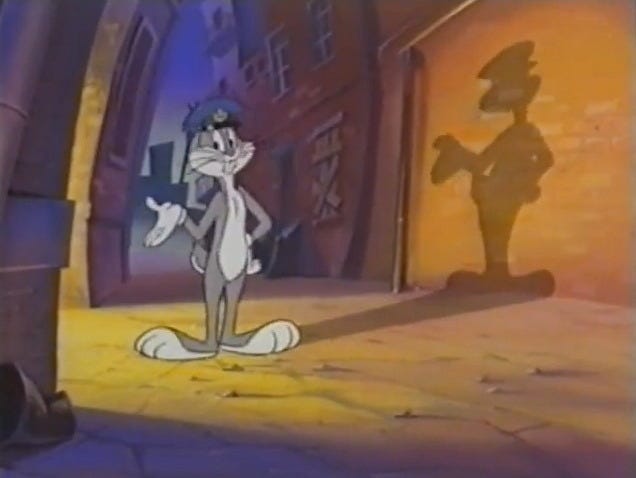
Our communal library class experience was not spared by these growing pains. Over a somewhat truncated period of time, the genuinely entertaining drug movie would transform into an ironic experience of laughing at Bugs Bunny talking about joints of weed. Even the films that we largely enjoyed were often reduced to peanut gallery heckling, because it was one of our favorite sports at this juncture of our development.
This also made classmates bringing tapes from home a lot more challenging, as they had to pass the gauntlet of our now incredibly picky and varied standards for what constituted worthwhile entertainment. I still remember the humiliation I endured when I brought in a VHS tape of Antz only to get soundly rejected by my classmates when they found it to be dull, gauche, and totally poopy.
(I am more understanding of this social castigation these days. After all, I had requested that they devote their precious weekly movie time to an animated film revolving around an insect version of Woody Allen.)
Lend an ear to this corn
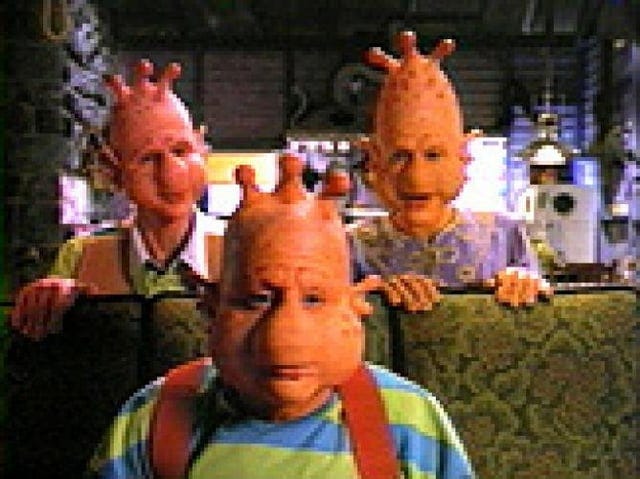
I am going to stop beating around the bush and make it clear that my choice of the word “corny” was deliberate.
You see, even before all the beleaguered cynicism of aging set in, my class never had any sympathy for the plight of Corny (proper noun).
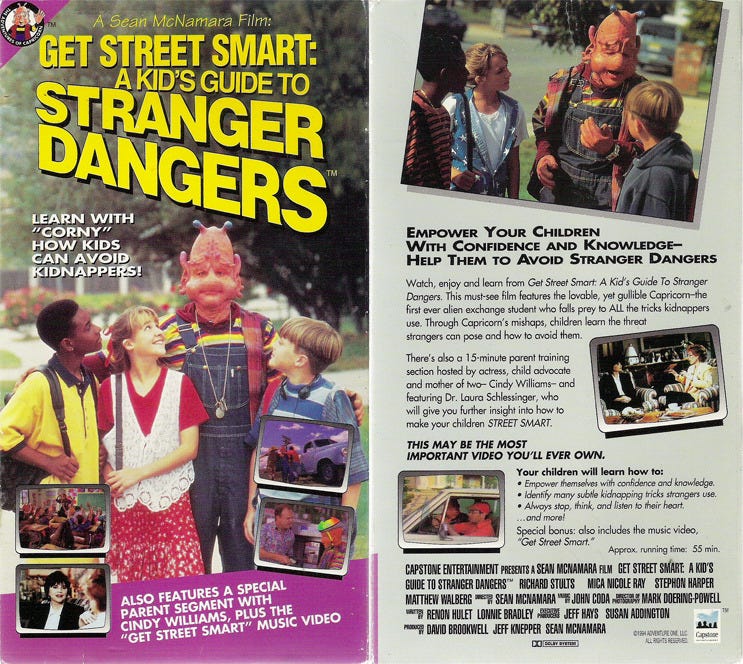
Corny the alien, full name Capricorn, was a horrifying creature allegedly conceived to entertain young children and educate them about the various dangers that could befall them in their young and naive lives. He was presented as a grown man in a large, flesh-colored rubber suit. Personality-wise, he had a mien similar to Mork (from Mork & Mindy, duh) with every shred of charisma violently vacuumed from his body, as if he were the victim of some kind of wretched Ayn Rand-conceived surgical procedure.
No matter how young we were when my peers and I first clapped eyes upon Corny, we were not amused with the execution of the film. We found the alien himself to be an obnoxious creature forged in the fires of hell, which, as you can imagine, was a pertinent complaint when every classroom had pictures of Jesus and Mary on the walls.
This disdain only grew with every passing year, as we withdrew from sincerity and began to enter that aforementioned stage of irony and persistent scorn of anything we deemed uncool and babyish.
We would watch Corny undergo the same VHS adventure year after year, often requested explicitly to relish in jeering at him and hoping for his suffering. His pain made us laugh. His struggles gave us joy. One could only imagine that one of those pictures of Jesus was weeping. We wouldn’t have noticed. We were too busy mocking Corny.
Pause for an homage to Ants on Drugs cinema
There was a strange end and winding road that led me back to rediscovering Corny.
These days, YouTube is abundant in videos that preserve and share obscure VHS memories from childhood that were once highly esoteric and largely concentrated in specific communities, classrooms, and family entertainment rooms. My starting point was The Adventures of R.F. Ant, a half hour tape about the dangers of stimulant drugs.
Actually, that’s not quite correct—my starting point was an short series of extracted clips from the tape simply titled “Ants on Drugs.”
I had a considerable amount of consternation and critical thought about this truly bizarre piece of public service announcement history. The least of these was that probably would have just gone forgotten in a world where common internet outposts of “remember when” like YouTube, Reddit, or the Internet Archive had never come to pass.
But beneath all the baffled thoughts I had about this specific piece of insect media, I was also triggered to begin seeking out examples of this unique era of child education media that my generation had grown up with. This is what led me back to Corny.
Don’t talk to drugs
It could be said that the ‘90s were a generation in which children often found themselves proverbially packaged in bubble wrap. The media landscape was awash with public service announcements about the dangers of drugs, strangers, and various other social malfeasances that could inflict harm upon innocent children. The drug movie was one of the earliest and most prominent examples of this art movement.
As what was termed “The Crack Epidemic” was in full swing and the war on drugs raged on from the Reagan years, the youths of the ‘90s were being preemptively protected from anything that might send them into the waiting arms of dangerous predators or drug dealers. I can imagine no other circumstances leading to a creative team wanting to make a VHS tape about ants who use crack cocaine.
Corny the alien, as we knew him, was a mascot warning children of stranger danger. And when I stumbled upon a copy of the tape, readily uploaded to YouTube and heavily criticized by many content creators already, I quickly realized that the ire my class held towards this extraterrestrial was not entirely based on the bizarre costume, nor a burgeoning disdain for baby shows. Corny, for whatever reason, was seemingly built to be hated.
Getting to the bottom of #CornLore
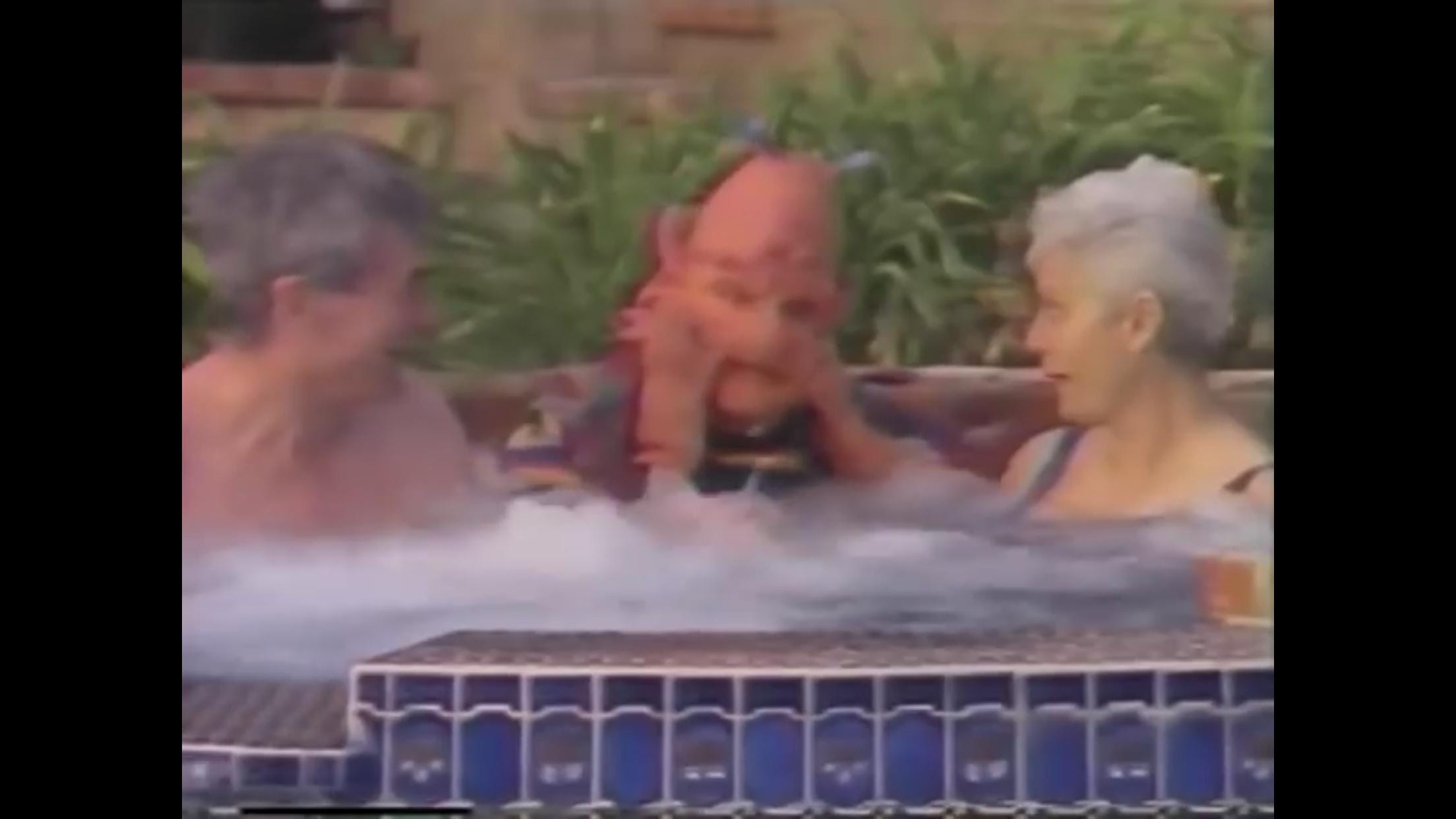
The story of the tape, running a little less than an hour, concerns alien exchange student Corny learning in class about the methods of avoiding dangerous strangers trying to abduct him. Corny, however, hates paying attention and learning from his mistakes, and keeps forgetting his education and getting abducted on a daily basis.
Using his sci-fi wrist device to teleport back to the morning, he gets caught in a time loop that repeats until he finally learns how not to be kidnapped by the apparent panoply of child predators that populate his neighborhood.
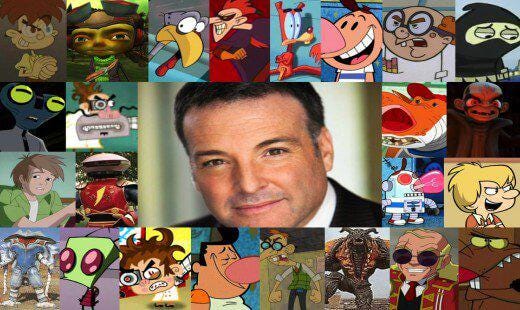
There are a lot of reasons to scratch your head at this tape. Corny himself is played by Richard Horvitz, who would go on to be one of the most decorated children’s voice actors of his era—you might know him better as the voice of another, far more popular children’s television alien, Invader Zim.
The presentation’s cheesy theme song has very clunky lyrics. Much of the script insinuates this was intended to be a longstanding series with deeper lore and more heavy science fiction elements. As I mentioned, there are many, many child predators who attempt to abduct Corny and his friends throughout the video—particularly concerning when it seems like Corny and his peers are latchkey kids in such a dangerous town.
It also runs into the common snafu of not wanting to say outright why adults might want to kidnap a child, for obvious reasons. So we get a lot of bizarre, indecipherable aggression from these nameless adult villains. They also seem to repeatedly zero in on Corny in particular, even before his lack of savvy is apparent. Maybe they just want to sell him to the CIA for research.
Strangely enough, Corny’s struggle is not framed as particularly sympathetic. The cast and narrative seem as frustrated with Corny’s repeated inattention as the audience is. His so-called friends don’t seem to like him very much at all, regarding every remark he makes with disgust and annoyance. His teacher struggles to restrain her irritation. Even his parents teeter into impatience.
In this sense, we are all invited to hate Corny. And maybe this is a good thing.
Learning how to hate, healthily
There is no denying the fact that this cynical era of child development can be uniquely frustrating to deal with from the outside. A few years later, I would end up working as a counselor at a summer camp for a bunch of preteens and find myself at my wit’s end with their constant abrasive and adversarial conversation tactics. It is simply no fun to navigate, and I highly sympathize with my teachers who have been on the blunt end of my own sass growing up.
In spite of that frustration, however, I think this is a vital component of growing up. We simply cannot live in that blissful ignorance and naiveté forever. But beyond that, there is simply a supreme value in learning how to properly hate things. For all the many truisms and memes about being a hater these days, developing a palate for what you dislike is just as important as knowing what you like, for many reasons.
During this era of our development, we start to learn what hating something truly means beyond just having to clean our room or eat broccoli. When we exacted our hatred upon Corny, we were doing more than just getting wayward childhood energy out. We were past the gate of simply learning the essentials of reading, writing, and arithmetic, and were entering the era of sussing out how the things in our world made us feel, rather than just how they worked.
Whether the director of this little piece of cinema intended to or not, his perspective and framing of Corny as an odious creature not meant for this planet did a service in safely nurturing the negative spirit necessary to be a part of the adult world. All without actually hurting anyone!
Leaving the room where I had library class, basking in the glow of having piled searing hatred upon an underpaid actor in a crummy public service television program, I was armed with new skills that would allow me to engage with other subpar artworks. Perhaps hating Corny empowered me to one day explain why I hated certain movies on Letterboxd, or even to analyze novels while pursuing higher education.
Or maybe it did absolutely none of that, and it was just fun to try my hand at being an asshole while still having my age in the single digits. Regardless of its outcome, I am grateful for Corny and the experiences he gave me.
He taught me maybe the most important lesson of all: that with the right creative circumstances, even the most sensitive child can feel nothing watching a fictional elementary school student be abducted by marauding strangers. And isn’t that just so much more magical than any Disney movie?